Nature In Motion: A Kinetic Biophilic Sculpture
Stress is a constant part of modern life, shaping how people think, feel, and move through the world. The outcomes are familiar, whether the environment is a hospital waiting room, a university study space during finals, or anywhere pressure and uncertainty run high: thoughts spiral as people worry about outcomes they cannot control, replay worst-case scenarios, or push themselves past exhaustion.
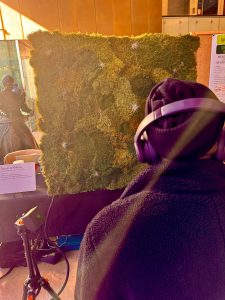
Access to nature is one of the most reliable ways to interrupt that cycle. Natural environments are known to calm the nervous system, restore attention, and reduce stress. Yet many high-stress spaces are designed with little or no connection to the outdoors. Hospital rooms, interior classrooms, testing centers, and study halls do not consistently offer sunlight, greenery, or a view beyond a wall.
This kinetic moss wall was created in response to that gap.
The installation introduces a living, moving presence into indoor environments. Made with preserved moss and air plants, the piece moves in a slow, rhythmic way that emulates breathing. This is done through an array of robotic actuators and 3-D printed parts that the fellows assembled behind the moss wall itself. It functions as a window to nature where no physical window exists, and is designed to survive without access to sunlight. The installation is informed by biophilic design principles, which recognize humans’ innate connection to nature, along with research showing that natural forms, motion, and sound can provide health benefits. The experience engages the viewers with calming, nature-based sounds delivered through noise-canceling headphones that accompany the motion, creating a multisensory experience that viewers have described as “like being sucked into a different world.”
The fellows presented the project at the Alliance for the Arts in Research Universities (a2ru) conference to gather feedback before advancing the work into a formal research study with the People and Robots Lab. The piece sought to reframe robotics away from speed, efficiency, and productivity, and toward presence, reflection, and emotional well-being. As an exploratory work, it considers new forms of robotic systems that are biophilic or meditation-based.
Initial feedback suggested that viewers felt they were already “breathing in sync with the movement.” This observation has shaped future research questions, such as the effect of adjusting the piece’s movement to match a viewer’s breathing rate and then gradually slowing it. Could that encourage the body to slow its breath in response?
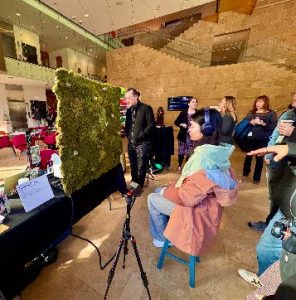
Future iterations of the work aim to explore guided meditations in relation to the kinetic movement. These may include synchronized breathing exercises where the piece breathes in and out as the meditation guides the viewer to do the same, and movement-based meditations that encourage the body to mirror the motion of the piece. Additional approaches include touch-based meditations that invite gentle exploration of different parts of the form, and environmental connection meditations that encourage gratitude and reconnection with nature. Together, these approaches explore a new form of meditation that is physical, spatial, and relational, rather than purely auditory or screen-based.
Some viewers described the breathing motion of the moss as “calming but uncanny,” likening it to a peaceful, alien presence. This response also opens further avenues for exploration, including whether more familiar natural movements, such as the swaying of a tree in the wind, may feel more grounding. Future biophilic robotic forms can build on these insights to better understand how motion, material, and form influence emotional response.