Rhapsody of Genetics

This project puts forth an algorithmic composition system that converts the fundamental blueprint of life (DNA) into a symphony of sound.
Rhapsody of Genetics is an interdisciplinary art–science project that transforms genetic information into original musical compositions. By mapping the biochemical properties of DNA and amino acids to pitch, rhythm, and instrumentation, the project renders the invisible language of genetics into an immersive auditory experience. The result is not simple sonification, but an automatic compositional system that preserves scientific accuracy while producing aesthetically complex audio.
Developed through the Kohler Fellowship program, the Rhapsody of Genetics demonstrates how computational biology and music composition can work together to make complex science perceptible, emotional, and accessible to public audiences.
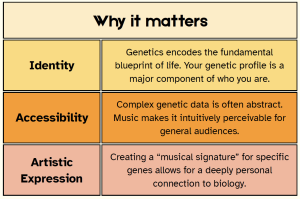
Genetic sequences encode the fundamental blueprint of life, yet they remain abstract and inaccessible to most people. Rhapsody of Genetics asks a simple but powerful question: What if you could hear your DNA?
Rather than assigning arbitrary sounds to genetic symbols, the project uses measurable molecular properties—such as amino acid hydropathy, DNA molecular weight, and hydrogen bonds—to determine musical parameters. These biological characteristics directly influence rhythm, choice of percussion instruments, relationship between the pitch classes, and instrumentation, allowing genes to generate their own distinctive musical identities.
At the core of the project is the world’s first web-based Genetic Music Browser that parses user-selected genetic sequences in real time and produces multi-track musical output. As a prototype, the team sonified and presented the human FOXP2 gene, which plays a key role in speech and language development. This demonstration illustrates how complex genetic information could translate into audible changes in musical texture and form.
Future development of the project will include mapping more layers of genetic data, such as gene expression and chromatin accessibility, to more music parameters like dynamics, articulations and tempo changes. The team also plans to add animated visualizations of protein structure.