The Power, The Shiver, The Anthropocene: An Exhibition on the Great Texas Freeze
An Amnesty International 2024 report on the US petrochemical industry’s toxic pollution called Texas’s Houston Ship Channel a “sacrifice zone.”
The smell of money pervades the air of the Houston Ship Channel, the second-largest petrochemical complex in the world. To many Houston residents, the smell is that oil, gas, and air pollution. The Houston Ship Channel, an oil and gas metroplex stretching from Baytown to Galveston, makes Houston one of the most polluted cities in the United States, while simultaneously making the most money per capita from oil and gas. Billboards for personal injury lawyers stretch across multi-lane highways. Residents spend their lives drilling for oil to feed the international reliance on petrochemical resources, a reliance that not only fuels the modern descent into climate change, but also caused a catastrophic energy crisis across the state.
This exhibition presents the cyclical relationship between petrochemical pollution, public health, federal oversight, and theERCOT (Electric Reliability Council of Texas, Inc.) electricity grid. InFebruary, 2021, during Winter Storm Uri, these factors converged to cause one of the worst energy crises in US history, also known as the Great Texas Freeze. This storm event lastedover eight days, leaving 80 million people without power and killing an estimated 246 to 700 people, many of whom were already medically vulnerable.
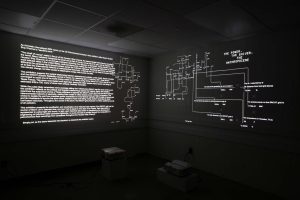
While the public likely remembers news coverage stating that “infrastructure failure” was the cause ofthis event, this exhibition reflects on the political and financial underpinnings of the tragedy. Mainly,the exhibition examines the autarchical choice of Texas politicians to separate the ERCOT power grid from the North American interconnected network of electricity, making Texas unable to utilize shared power in times of emergency. This choice to isolate the grid from interstate power connections to avoid federal regulation left the state, its power grid, and its inhabitants to survive the storm alone, amidst a frozen and failing energy system dominated by fossil fuel-based resources. Throughout the course of the storm, the ERCOT grid produced 35 million additional pounds of air pollution.
This exhibition presents the sonification and visualization of six historical data metrics of the ERCOT grid over the course of Storm Uri in distorted time; one hour here is equal to nine days of theFreeze. Each data metric is represented in paired light and sound. Each historical data stream is visualized by the dimming and brightening of individual DMX-controlled lightbulbs. The data is sonified through the manipulation of petrochemical field recordings from complexes throughout the Houston Ship Channel. Simply put, as the storm plunges Texas communities into blackout, so descends the exhibition space.
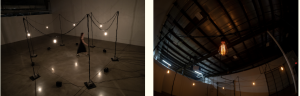
The exhibition was shown at Backspace Gallery from September 25th–October 11th, 2025, with a reception on September 26th. Over 40 people engaged with the exhibit during the reception, as well as others in the days to follow.
Stakeholders in Houston, TX, have expressed interest in hosting this exhibit and have begun coordinating this potential with the Kohler Fellows, Anne & Ashley.
If you’d like to experience the exhibition, please watch at the link below: